
2026-05-14
Share


Introduction: In today's highly competitive commercial complex landscape, how do you create a visual landmark that drives sustained foot traffic and possesses extreme operational stability? In 2026, Siam Paragon, a premium commercial complex in Bangkok, Thailand, provided the answer. In the atrium of its newly built mall, a stunning 4.8-meter diameter, P3 pixel pitch indoor LED sphere display was lit up.
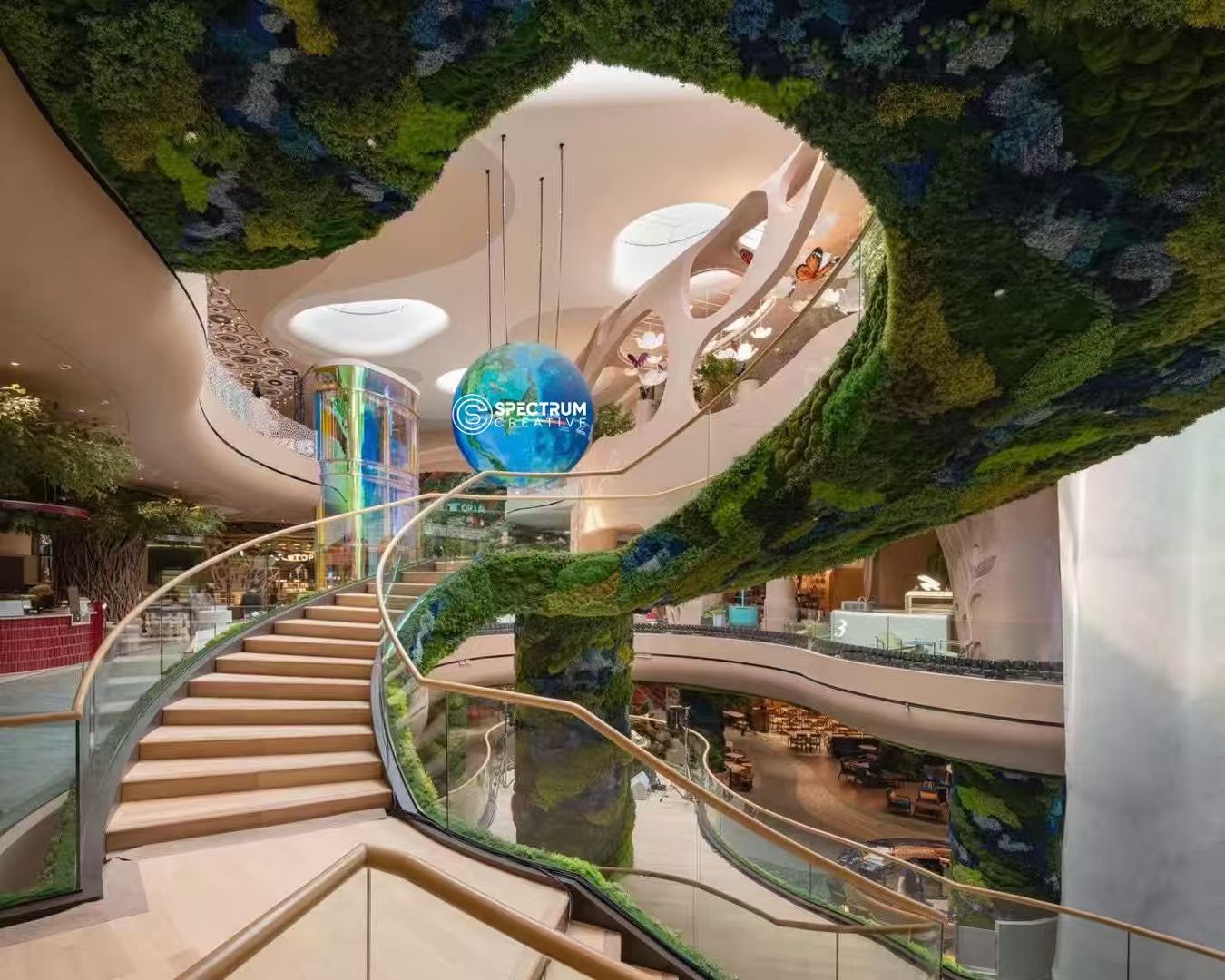
This was not a simple hardware splicing job. It was a milestone engineering feat by Spectrum Creative, acting as an overarching ecosystem builder, transforming highly complex "non-standard custom displays" into "standardized commercial operational assets." This article will provide an in-depth breakdown of the technical logic and engineering philosophy behind this project.
In top-tier commercial spaces, Sphere LED displays have always been favored by premium brands for their 360° blind-spot-free visual impact. However, transitioning a sphere display from a "short-term art installation" to a "long-term commercial asset" has left the entire industry facing three seemingly insurmountable mountains:
The "Blind Box" Effect of Structure and Delivery: Traditional custom sphere displays heavily rely on the manual splicing and debugging experience of on-site workers. Lacking a standardized implementation path, projects often face risks of extreme implementation complexity and severely delayed delivery cycles.
Catastrophic Visual Stretching: Projecting flat digital assets (video) onto a 360° sphere through sheer hardware stacking—without underlying algorithms—inevitably leads to "severe stretching at the equator and frantic pixel squeezing at the poles." This completely obliterates the fine image quality required for high-end commercial spaces.
High-Stakes Post-Maintenance: In a 24/7 high-frequency operational environment like a shopping mall, if a single LED bead breaks and requires dismantling half the sphere for rear maintenance, the resulting business disruption and exorbitant maintenance costs are absolutely unacceptable to mall operators.
Faced with the rigorous demands of Siam Paragon, Spectrum Creative had only one core solution: Engineering and standardizing non-standard sphere displays.
As a highly anticipated new premium commercial project in the region, the construction window left for the atrium's visual landmark was incredibly short. From finalizing the proposal to the on-site lighting, Spectrum Creative's engineering team had only about 8 weeks. Even more daunting, the site presented immense challenges: restricted night-time construction hours and the need for rigorous secondary verification of the atrium's structural load-bearing capacity.
To avoid disrupting the mall's overall opening preparations, we completely overturned traditional on-site construction models:
Lightweight Structure & Load Resolution: To address the mall's load-bearing limits, the team redesigned the internal skeleton of the sphere using aviation-grade lightweight aluminum alloy. This drastically reduced the overall load while ensuring absolute structural safety.
Factory Pre-assembly & Modular Splicing: We front-loaded the most time-consuming "spherical splitting logic and module layout testing." At our Shenzhen production base, the team completed a 1:1 simulated assembly and system pre-commissioning.
Seamless On-Site Execution: Upon arrival in Bangkok, the equipment was assembled in a highly modular state. This not only compressed on-site construction time by over 60% but also circumvented the unpredictable risks of non-standard projects, culminating in a flawless lighting before the mall's opening—setting an industry benchmark for "8-week ultra-fast delivery."
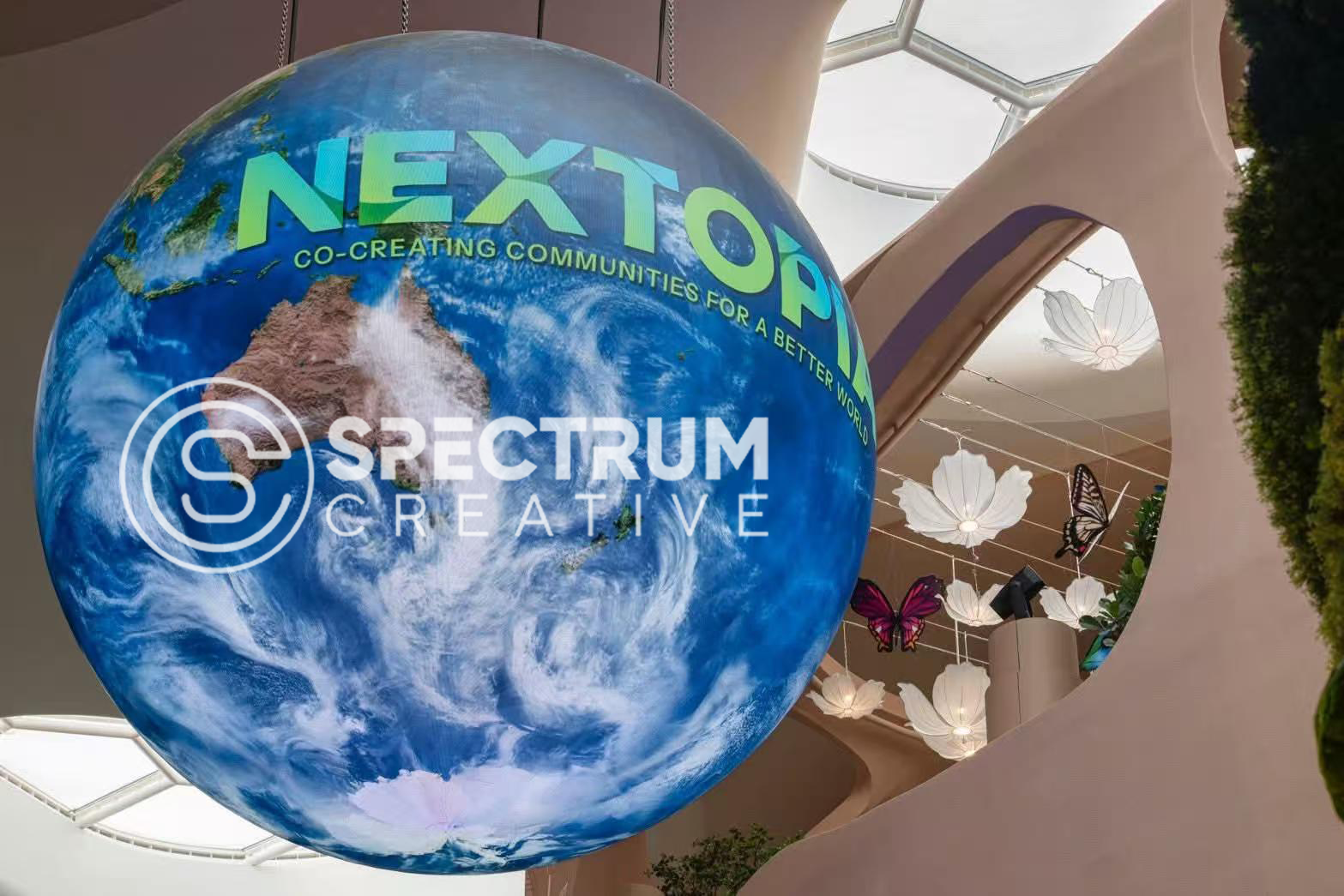
With the physical hardware assembly resolved, the more core challenge lay in the "lossless presentation of image quality." This was exactly the battlefield where Spectrum Creative's foundational software, certified by the National Copyright Administration—the Dome Panoramic Playback Control System V1.0—played a decisive role.
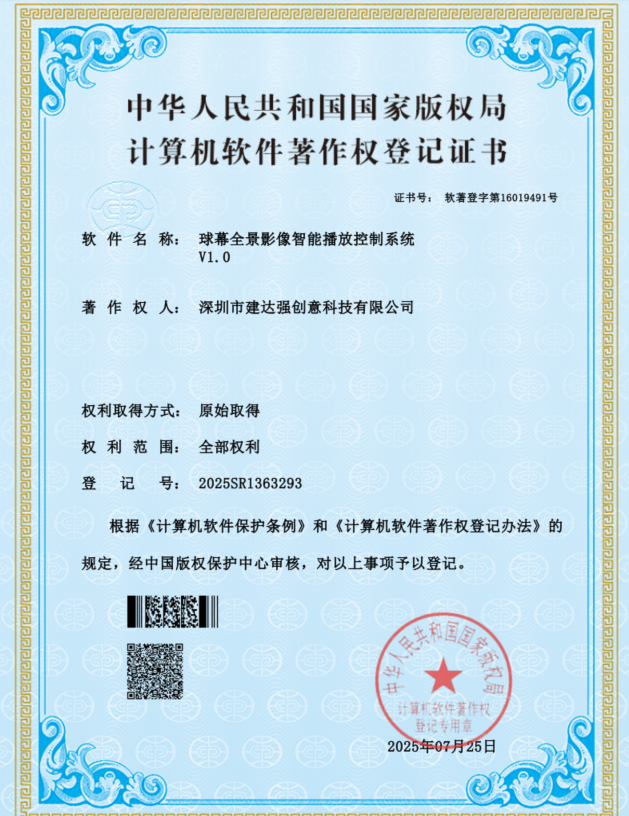
For the Siam Paragon project, this system demonstrated overwhelming algorithmic advantages:
High-Precision Spherical Resampling Technology: Embedded with an industry-leading spherical mapping underlying algorithm, the system abandons crude "image tiling." Instead, it automatically calculates the 3D coordinate system of panoramic images. It allows massive 8K video data to accurately land across hundreds of custom modules, completely eliminating tearing and stretching when visuals cross seams.
Zero-Latency Microsecond Synchronization: Tailored for P3 high-density pixels, the system achieves microsecond-level synchronization of multi-channel decoding, ensuring absolute fluidity for a 360° viewing angle.
This underlying algorithm completely liberated the content creation team. The mall no longer needs to spend exorbitant amounts creating "special distorted videos." By simply inputting standard 3D panoramic footage, the system can render immersive visuals perfectly tailored to the 4.8-meter sphere in real-time.
Lighting the screen is only the beginning; years of stable operation form the ultimate assessment standard for a commercial complex. In the Siam Paragon project, Spectrum Creative fully considered the mall's continuous operational characteristics:
Standardized Full Front-Maintenance Design: We discarded traditional, complex rear-maintenance structures. Every single module of the entire 4.8-meter sphere supports independent Front-maintenance. If a rare module failure occurs, an engineer only needs to stand outside the sphere to complete the replacement within minutes. This standardized maintenance ensures that repairs never disrupt the mall's daily foot traffic and business operations.
Flexible Content Asset Empowerment: Post-launch, the sphere rapidly transformed the area into a core Bangkok hotspot through seamless switching between 3D immersive visuals, high-end brand collaboration content, and event modes. It significantly increased consumers' Dwell Time, and its status as a "landmark visual installation" triggered massive organic spread across social media.
The 4.8m P3 indoor LED sphere project at Siam Paragon, Thailand, is not just a visual triumph; it is the ultimate best practice of Spectrum Creative upgrading "non-standard custom displays" into "mature commercial applications."
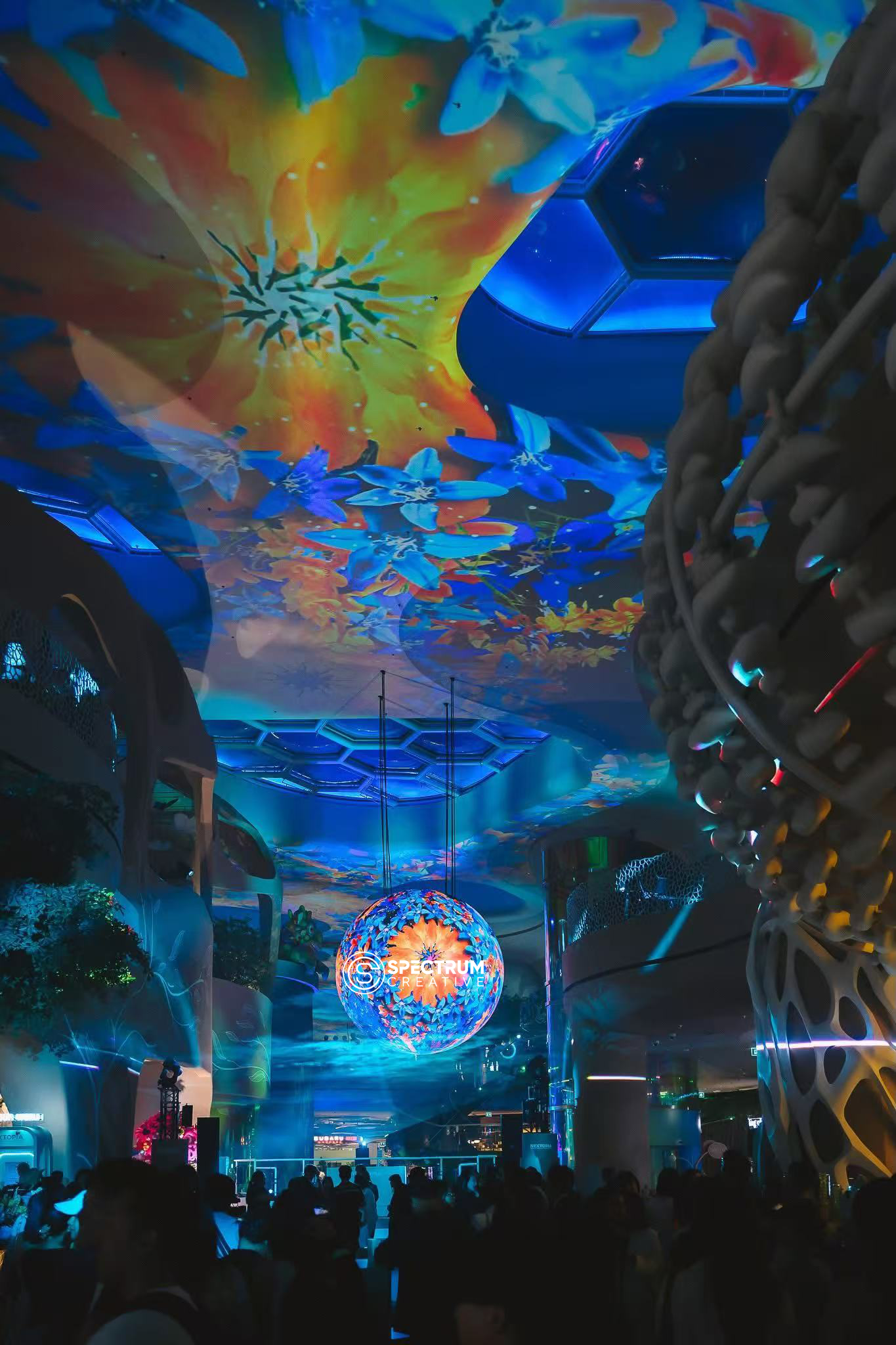
Through systematized structural design, the backing of underlying algorithms, and forward-looking operational maintenance mechanisms, we have provided a highly valuable engineering methodology for similar custom display projects globally. By choosing Spectrum Creative, you possess not just an eye-catching screen, but a stable, easily maintained digital lifeform capable of generating continuous commercial returns.
Q1: Compared to standard flexible screen splicing, what are the advantages of Spectrum Creative's systematized sphere solution?
A: When ordinary flexible screens are spliced into a sphere, severe gaps and visual distortion easily occur at the poles. Spectrum Creative utilizes exclusively customized irregular PCB modules combined with an underlying coordinate resampling algorithm, achieving true dual seamless splicing—both physically and visually.
Q2: If we deploy this in a mall, will future content updates be complicated?
A: Not at all. Thanks to our Dome Panoramic Playback Control System V1.0, your creative team only needs to provide standard 360° panoramic video or 3D animation sources. The software automatically performs real-time anti-distortion mapping, eliminating the need for exorbitant video customization fees and making content updates highly flexible.
Q3: With a sphere as large as 4.8 meters, will its weight pose a safety hazard to the mall's ceiling or floor?
A: We initiate secondary structural load verifications at the very beginning of the project. By utilizing aviation-grade aluminum profiles combined with a lightweight module design, the weight is reduced by over 30% compared to traditional steel-structured spheres, perfectly meeting the load-bearing requirements of newly built malls or retrofitted older properties.